About Conference
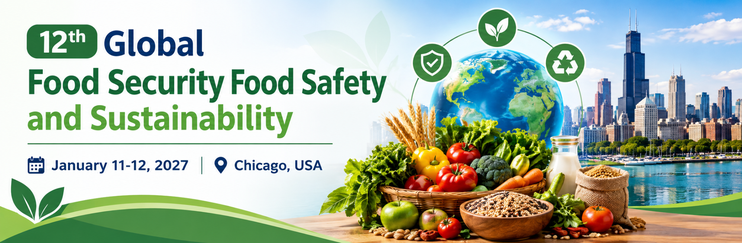
Conference Series LLC Ltd with immense pleasure invites all the contributors across the globe to the “12th Global Food Security, Food Safety and Sustainability” conference during January 11–12, 2027 in Chicago, USA, focusing on the theme “Innovative Strategies for Global Food Security, Food Safety and Sustainable Food Systems.” The conference will bring together leading experts, researchers, scientists, academicians, policymakers, industry professionals, agriculturists, environmentalists, economists, and students to exchange knowledge and discuss innovative solutions for the future of global food systems. The program will feature keynote presentations, plenary talks, oral presentations, poster sessions, interactive discussions, expert forums, and exhibitions.
Details of Food Security 2027 Conference
|
Conference Name
|
12th Global Food Security, Food Safety and Sustainability
|
|
Place
|
Chicago, USA
|
|
Date
|
January 11–12, 2027
|
Food Security is a global priority that encompasses food availability, accessibility, utilization, quality, and stability. With growing populations, climate change, environmental challenges, resource limitations, and changing food systems, ensuring access to safe, nutritious, and sustainable food has become increasingly important. The conference will provide an international platform to explore innovative approaches in sustainable agriculture, food safety, nutrition, food production, food technology, climate-resilient food systems, and policies that can contribute to a secure and sustainable global food future.
We warmly invite researchers, scientists, academicians, food technologists, agricultural experts, policymakers, industry professionals, environmentalists, economists, students, and other professionals to join us in Chicago, USA, for the 12th Global Food Security, Food Safety and Sustainability Conference 2027.
The main aim of the conference is to provide an international platform for knowledge sharing, scientific collaboration, networking, and meaningful discussions among global experts and emerging researchers in food security, food safety, agriculture, sustainability, nutrition, and related fields. The conference will encourage the exchange of ideas, innovative research findings, practical solutions, and future perspectives addressing the challenges facing global food systems.
Benefits
-
Global Networking: Connect and collaborate with researchers, experts, academicians, and industry professionals from around the world.
-
Knowledge Exchange: Share the latest research findings, innovations, technologies, and best practices in food security, food safety, and sustainability.
-
Expert Forums: Participate in interactive discussions with leading experts and thought leaders.
-
Career Development: Explore opportunities for professional growth, collaboration, and academic development.
-
Research Visibility: Present your research through oral and poster presentations to an international audience.
-
Industry Interaction: Engage with professionals and organizations working on innovative food and agricultural solutions.
-
Collaborative Opportunities: Build new academic, scientific, and professional partnerships for future research initiatives.
Sessions &Track
Track 1: Global Food Security & Sustainable Agriculture
This explores innovative strategies to improve global food availability, accessibility, affordability, and nutrition. It covers sustainable agriculture, climate-smart farming, resilient food systems, agricultural productivity, and policies supporting long-term food security.
Track 2: Food Safety, Quality & Foodborne Diseases
This focuses on food safety throughout the food supply chain, from production to consumption. Topics include foodborne pathogens, contamination, food hygiene, risk assessment, quality assurance, food safety regulations, and emerging food safety challenges.
Track 3: Food Biotechnology & Microbiology
This highlights advances in biotechnology and microbiology for improving food production, quality, safety, and nutritional value. It includes fermentation, probiotics, microbial biotechnology, plant biotechnology, genetic improvement, and beneficial microorganisms.
Track 4: Food Processing, Engineering & Technology
This covers emerging technologies and engineering approaches for efficient, safe, and sustainable food processing. Topics include innovative processing methods, food preservation, automation, process optimization, nanotechnology, and advanced food manufacturing systems.
Track 5: Food Waste Management, Recycling & Circular Economy
This addresses global challenges associated with food loss and waste across production, processing, distribution, retail, and consumption. It explores recycling, composting, by-product utilization, waste-to-value technologies, and circular economy approaches for sustainable food systems.
Track 6: Food Chemistry, Nutrition & Nutraceuticals
This focuses on the chemical, nutritional, and biological components of foods and their effects on human health. It includes functional foods, nutraceuticals, dietary supplements, bioactive compounds, food additives, nutritional interventions, and emerging nutrition research.
Track 7: Food Packaging, Preservation & Shelf-Life
This explores innovative packaging and preservation technologies designed to maintain food safety, quality, freshness, and nutritional value. It includes smart packaging, active packaging, sustainable materials, shelf-life extension, storage technologies, and eco-friendly packaging solutions.
Track 8: Food Fraud, Adulteration & Authenticity
This examines food fraud, adulteration, mislabeling, counterfeiting, and authenticity challenges affecting the global food supply chain. It highlights advanced detection methods, traceability, analytical technologies, regulatory strategies, and consumer protection.
Track 9: Sustainable Livestock, Dairy & Aquatic Food Systems
This focuses on sustainable livestock, poultry, dairy, fisheries, and aquaculture systems that contribute to global food and nutritional security. Topics include animal nutrition, health and welfare, dairy technology, poultry hygiene, aquaculture, aquatic biodiversity, and sustainable animal production.
Track 10: Climate Change, Food Systems & Future Sustainability
This explores the effects of climate change, environmental pressures, and resource limitations on global food systems. It highlights climate-resilient agriculture, biodiversity conservation, water management, sustainable food production, innovative technologies, and policies for building resilient food systems.
Track 11: Agricultural Engineering and Machinery Development
This track focuses on the design, development, optimization, and evaluation of innovative agricultural machinery and equipment to improve farming efficiency, productivity, and sustainability. It covers advancements in farm mechanization, equipment performance, harvesting and postharvest technologies, soil management, crop handling, and the separation of agricultural products from unwanted materials. It also explores cost-effective machinery solutions, energy efficiency, equipment maintenance, and technologies adapted to diverse soil and field conditions, with the aim of reducing labor requirements, minimizing crop damage, and enhancing overall agricultural production.
Market Analysis
The 12th Global Food Security, Food Safety and Sustainability Conference, scheduled for January 11–12, 2027, in Chicago, USA, comes at a highly relevant time for the global food and agriculture sector. In 2026, food systems are being shaped by climate change, geopolitical instability, rising input costs, supply-chain disruptions, food safety concerns, and the growing demand for affordable and nutritious diets. The latest UN State of Food Security and Nutrition in the World 2026 reports that 2.1 billion people experienced moderate or severe food insecurity, while the affordability of healthy diets remains a major challenge.
-
Growing Global Food Security Demand: Food security remains a major international priority, with food insecurity expected to remain at alarming levels through 2026. WFP reports that 266 million people across food-crisis countries are facing acute hunger, creating strong demand for agricultural, nutritional, technological, and policy solutions.
-
Climate Change & Agricultural Resilience: Climate change is increasingly affecting crop production, water availability, livestock, fisheries, and food supply chains. The emergence of a potentially very strong El Niño in 2026 is adding further uncertainty to agricultural production and global food markets, increasing the need for climate-smart and resilient farming systems.
-
Food Commodity Market Volatility: Global food commodity markets remain exposed to geopolitical conflicts, weather disruptions, energy costs, fertilizer prices, and trade restrictions. The World Bank expects food commodity prices to increase in 2026, while warning that climate and geopolitical risks could push prices significantly higher than current projections.
-
Innovation & Agri-Food Technology: Science, technology, artificial intelligence, biotechnology, precision agriculture, digital farming, and advanced food processing are becoming increasingly important to improve productivity and resilience. FAO's 2026 Science and Innovation Forum highlights science, technology, innovation, responsible AI governance, and climate adaptation as key areas for transforming agri food systems.
-
Sustainable Agriculture Market: There is increasing market demand for climate-smart agriculture, sustainable production, efficient water management, soil health, biodiversity conservation, and reduced environmental impacts. Current investment initiatives demonstrate growing interest in climate-smart agricultural solutions, including proposed investments of USD 2.6 billion in Southeast Asia.
-
Food Safety & Traceability: Consumers, governments, and food companies are placing greater emphasis on food safety, quality control, traceability, contamination prevention, and supply-chain transparency. Technological advances are creating opportunities for companies developing rapid testing, digital traceability, authentication, and food safety monitoring systems. IFT identifies traceability and food-system resilience among important areas for food-sector innovation in 2026.
-
Food Waste & Circular Economy: Reducing food loss and waste is becoming an important commercial and environmental priority. Businesses are increasingly exploring food-waste valorization, recycling, by-product utilization, alternative ingredients, composting, and circular production models to reduce costs while improving sustainability.
Overall Market Outlook
The current market environment makes food security, food safety, and sustainability highly relevant investment and research priorities. The combination of climate risks, geopolitical disruptions, food-price volatility, nutritional challenges, technological innovation, and the need for sustainable production is creating new opportunities across agriculture, food technology, biotechnology, nutrition, packaging, food safety, supply-chain management, and waste reduction. The January 11–12, 2027 Chicago conference therefore offers a timely international platform to discuss emerging markets, technologies, policies, investment opportunities, and practical strategies for building secure, safe, resilient, and sustainable global food systems.
Past Conference Report
Food Security 2026
The 11th Global Food Security, Food Safety and Sustainability, held on January 29–30, 2026, in Chicago, USA, brought together researchers, academicians, scientists, industry professionals, and experts from diverse fields to exchange knowledge and discuss current developments in food security, food safety, and sustainability. The conference provided a valuable platform for scientific presentations, interactive discussions, networking, and knowledge sharing, with key areas including sustainable agriculture, food safety and inspection, food loss and waste, food production, environmental sustainability, and resilient food systems. Participants shared innovative ideas, research findings, and practical approaches to address emerging challenges in the global food sector and explored opportunities for future collaboration. The conference emphasized the importance of interdisciplinary cooperation and innovation in developing safe, sustainable, and secure food systems for the future. We sincerely thank all speakers, delegates, researchers, academicians, industry professionals, sponsors, exhibitors, and participants for their valuable contributions and support in making the conference a successful platform for scientific exchange and professional collaboration.
Past Reports Gallery